
Project Type
Academic Project
Role
UX Designer
Problem
Taking medication has become a routine part of life for almost everyone—unfortunately, for some more than others. Tracking and organizing these medications can become increasingly difficult as they accumulate, and in some cases, forgetting a dose can be a matter of life or death. Losing track of a regimen can also be deeply concerning for the loved ones and medical providers of those who require daily prescriptions to function. Ultimately, people who struggle to remember their medication or cannot provide medical professionals with accurate information may be unnecessarily burdening themselves.
Solution
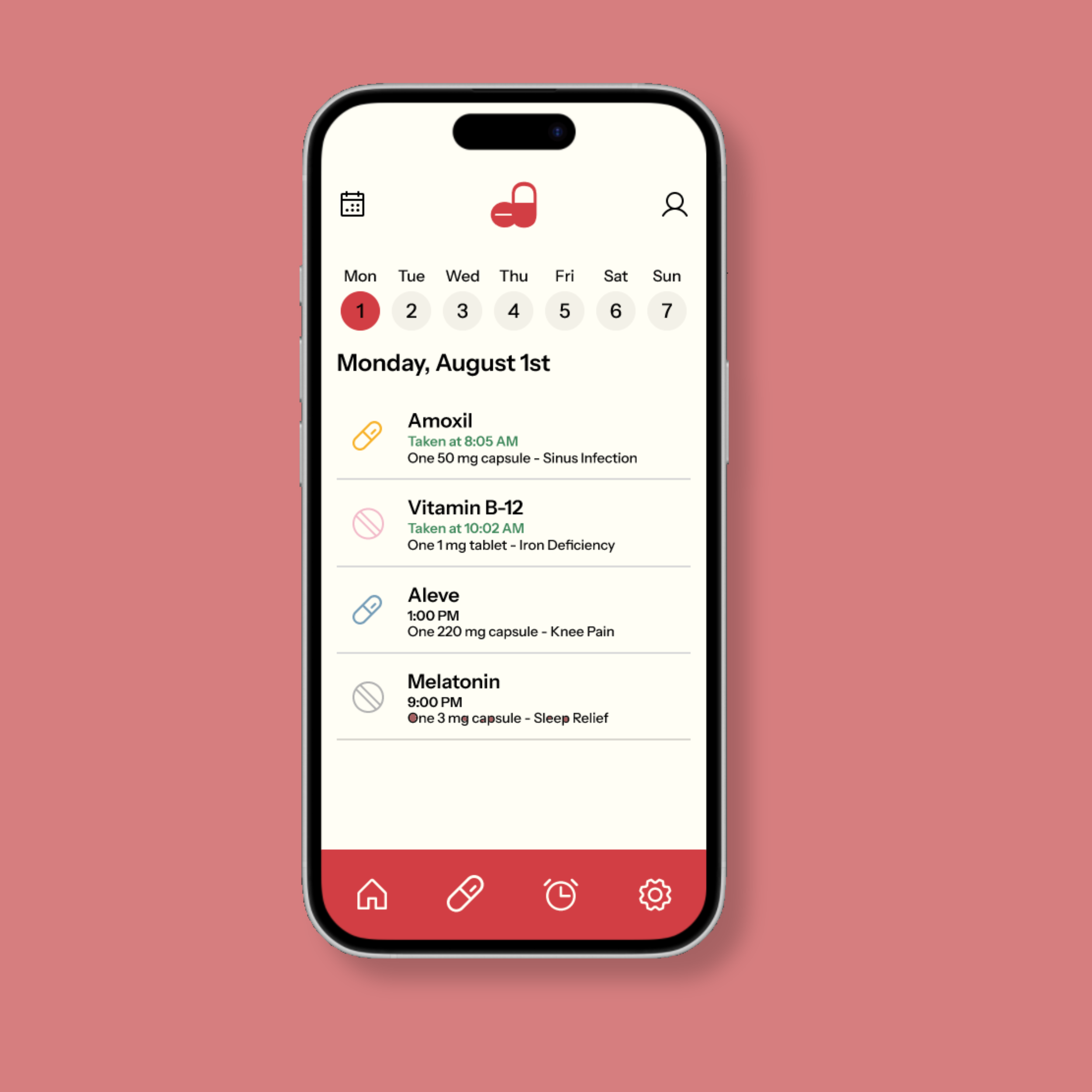
Dose serves as a modern solution to the age-old problem of forgetting prescribed medication. As a mobile platform, the app not only reminds users to take their doses but also allows them to maintain a comprehensive medication list for both personal reference and medical consultations. In today’s digital landscape, leveraging such tools is essential for maintaining the healthiest lifestyle possible. Ultimately, a wide range of demographics can benefit from a platform that organizes this vital aspect of everyday life.
Research
For this project, I began by researching multiple peer-reviewed journals that examined why and how people forget to take medication on a regular basis.
A study published in this first journal found a correlation between remembering where medication is stored and forgetting to take said medication.
Secondary Research
The Impact of Home Medication Management Practices on Medication Adherence
by Lisa Gualtieri ,Meredith Steinfeldt ,Eden Shaveet,Brandon Estime and Meera Singhal
Among adults with chronic conditions, 60% forget to take their medications occasionally
Forgetting to take medication is often a result of a hectic schedule or putting off getting necessary prescription refills
Sometimes forgetting to take medication may be intentional
A key factor in forgetting to take medications is where they are stored.
Forgetting to take medication is often a result of a hectic schedule or putting off getting necessary prescription refills
Specifically, people under 40 were significantly more likely to report that they forget to take their medications.
Unintentional non-adherence to chronic prescription medications: How unintentional is it really?
Abhijit S Gadkari & Colleen A McHorney
Younger age is strongly associated with increased unintentional non-adherence
Pain Points
Tracking Feels Like Extra Work
“I take this every day—I don’t want to log it every day.”
Logging medication can feel like too much effort
Users would benefit from a logging method that requires minimal effort
“I think I took it… But I’m not sure.”
Cognitive Overload & Reliance on Memory
In a life with many daily responisbilities it can be difficult to remember every part of your daily routine
Solely relying on memory to remember when to take medication can easily lead to skipped doses
App Constraints
Users may still forget or ignore notifications
Scheduled medical treatments may already be integrated into a personal calendar rather than a medication app
Medical Confidentiality
Technical Constraints
Users may not feel comfortable sharing the medications they are taking with an app
App design must be somewhat discreet to ensure users can utilize the app comfortably
People who aren’t routinely taking supplements may not see the need for the app
Social Constraints
Business Constraints
Even if put in a specific spot or a pill box, it can be incredibly easy to miss medications
When routines are disrupted (travel, crisis, etc) it is a vulnerable moment where people can forget to take their medication
Users may already have their medications tracked through the app associated with their pharmacy
It would be difficult to integrate forms of monetization into the app
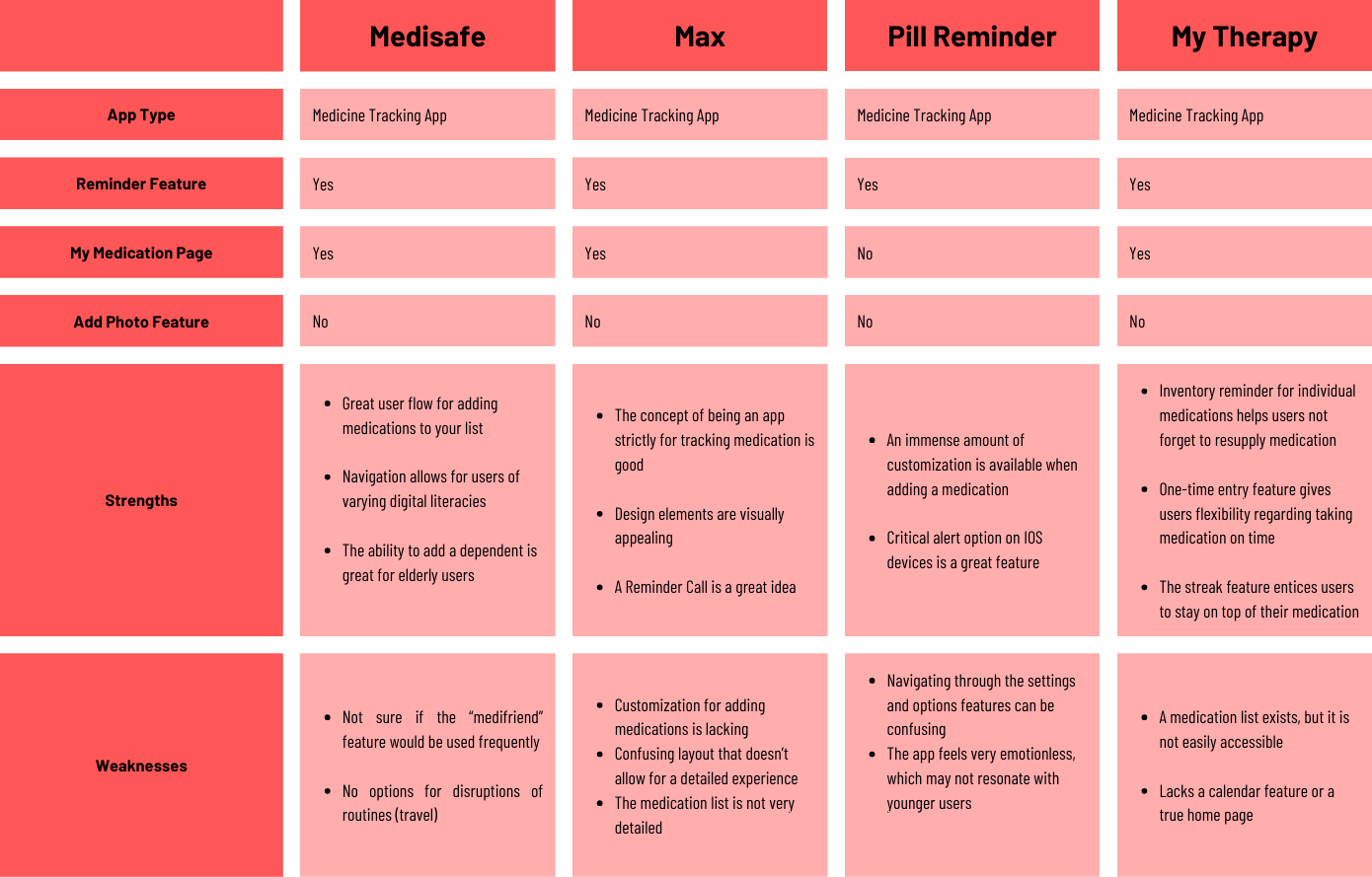
Market Research
Synthesis
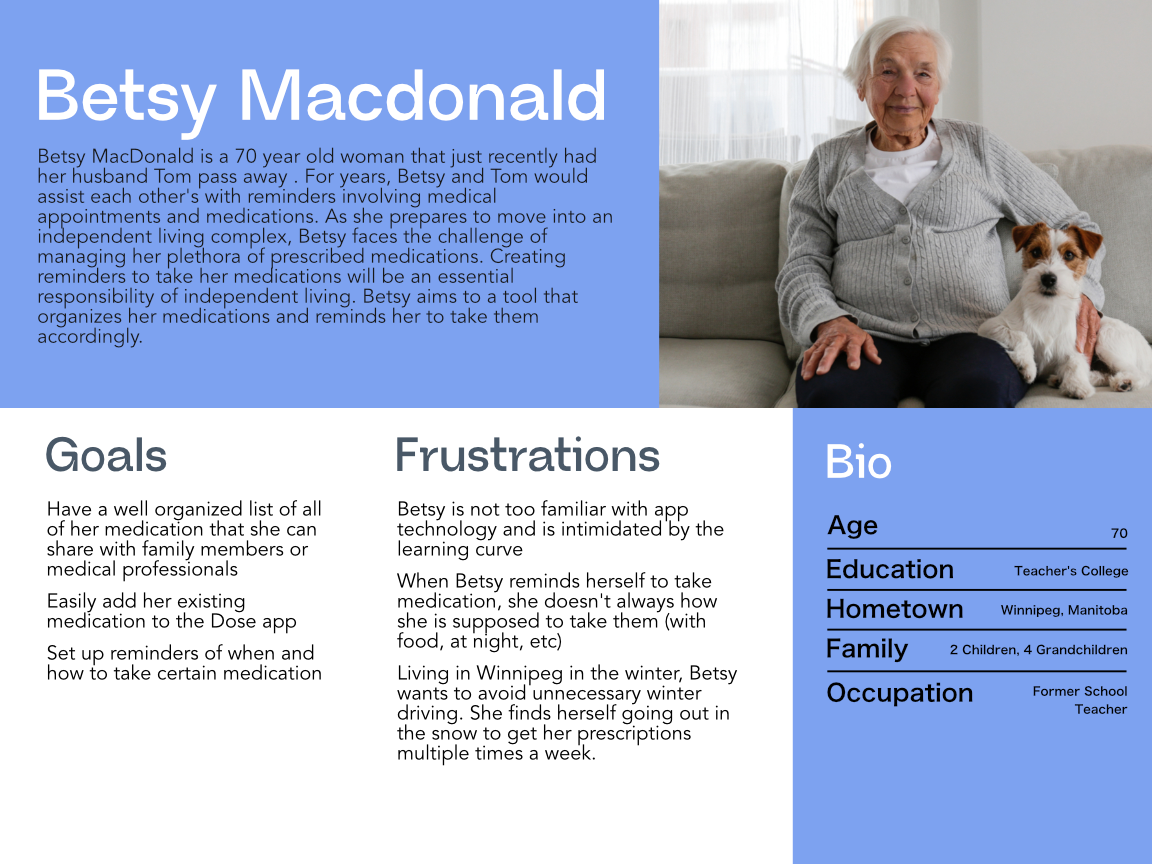
User Persona
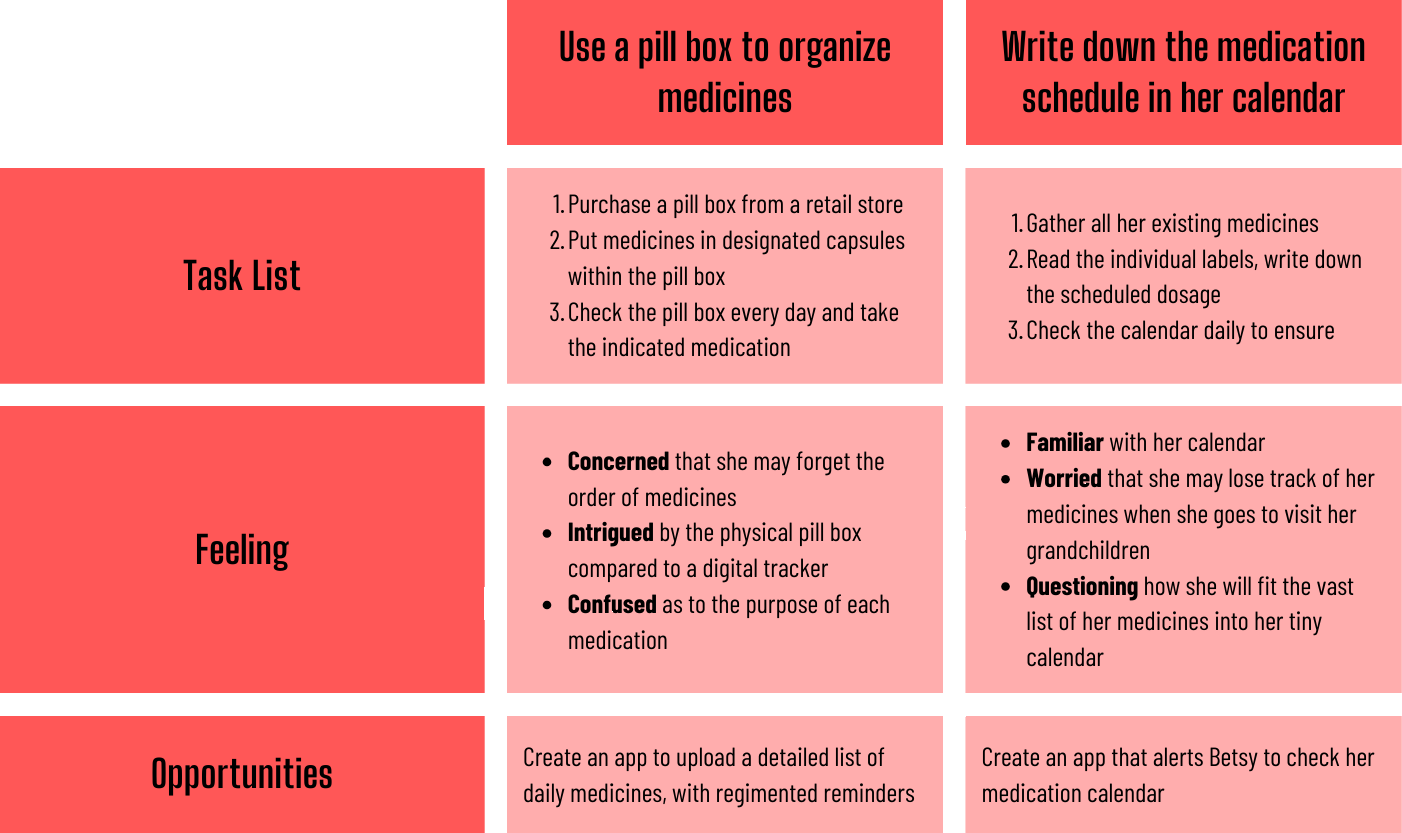
Expereience Map
User goal: To better organize her medication, thus simplifying her daily routine
Ideation
Digital Wireframes
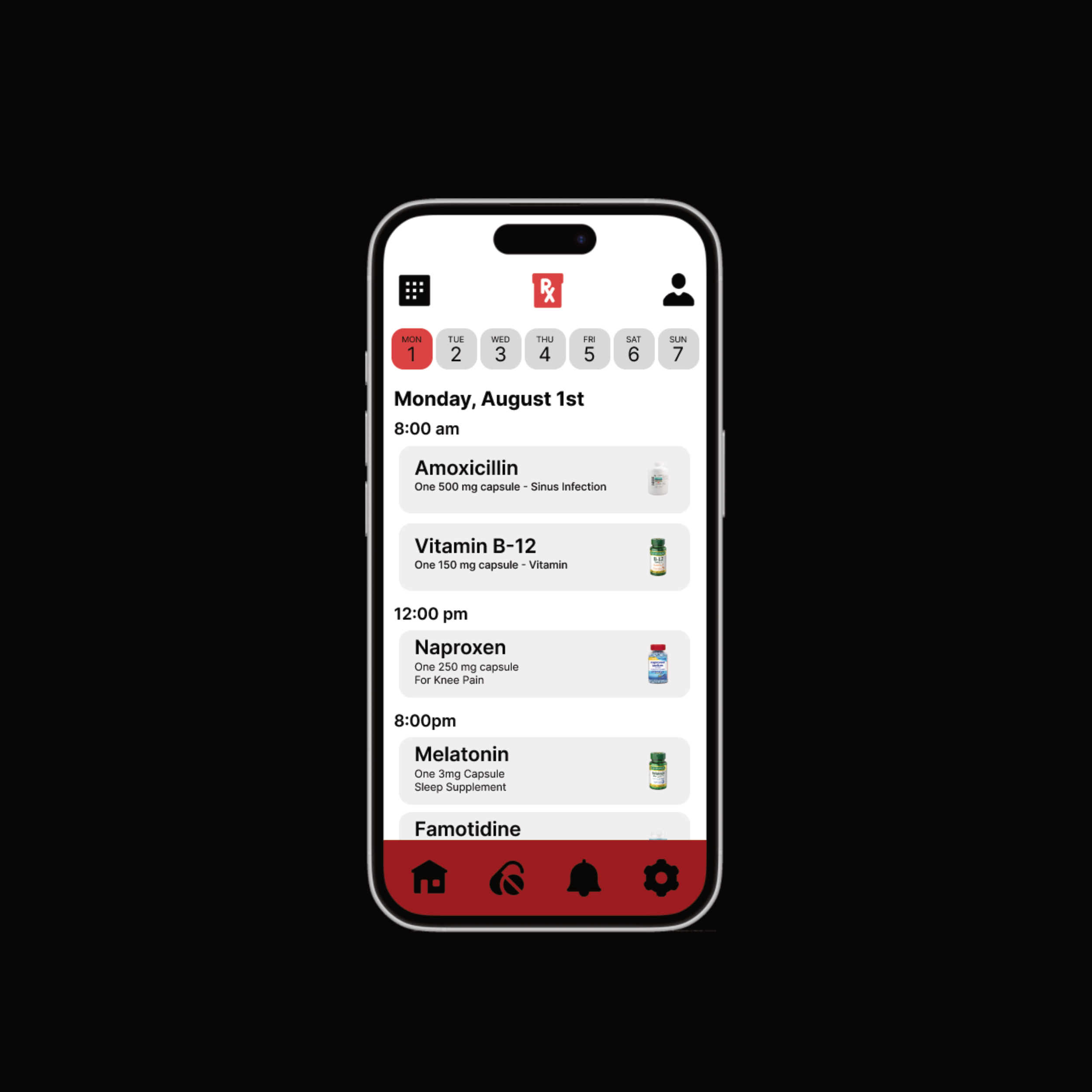
User testing
Goal: Assign the task of mopping the floor to roommate Santiago on January 4th.
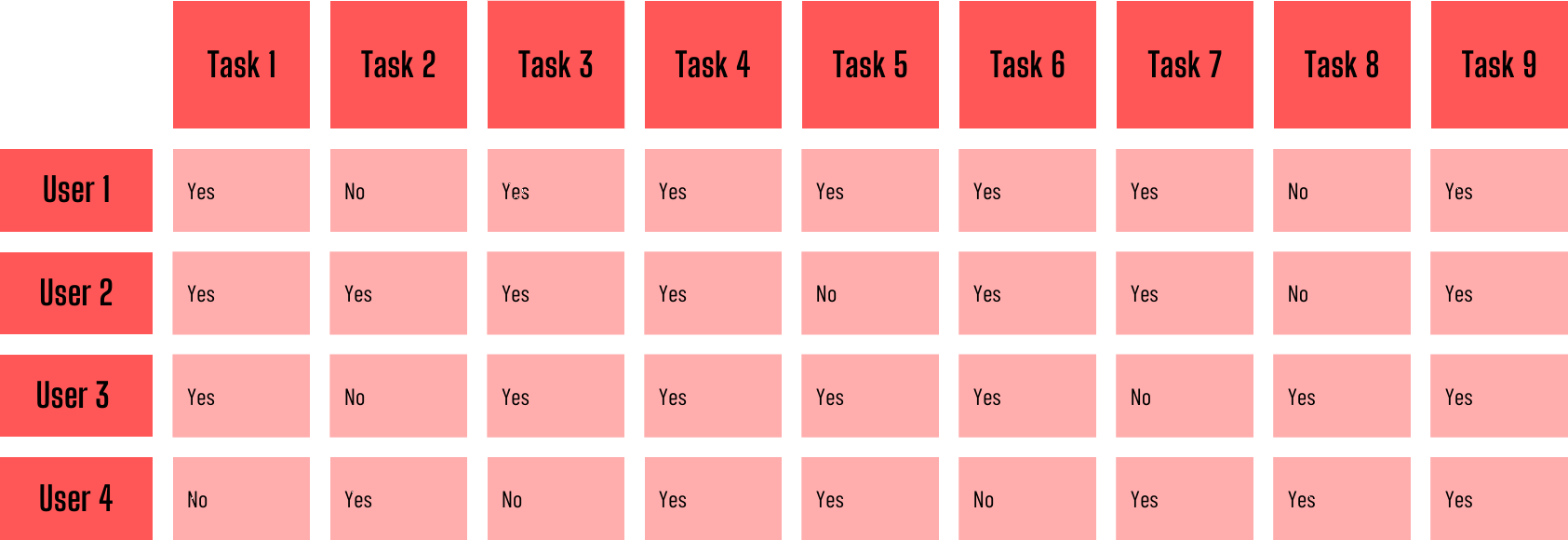
Task 1: Go to Medication List
Task 2: Select the add medication button
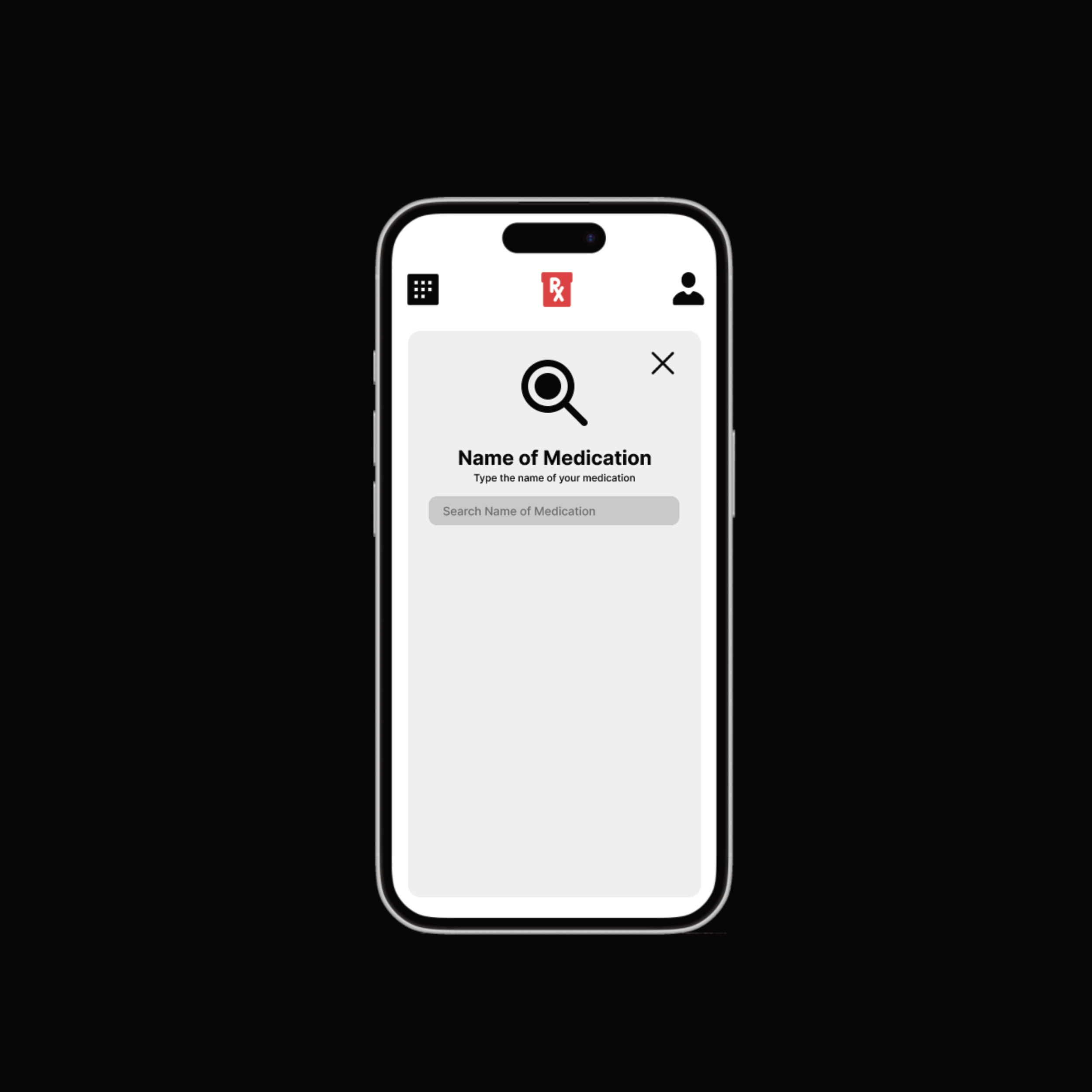
Task 3: Input the name of the medication
Task 4: Select a form of medication
Task 5: Input reason for taking the medication
Task 6: Select the frequency of doses
Task 7: Input time of required doses
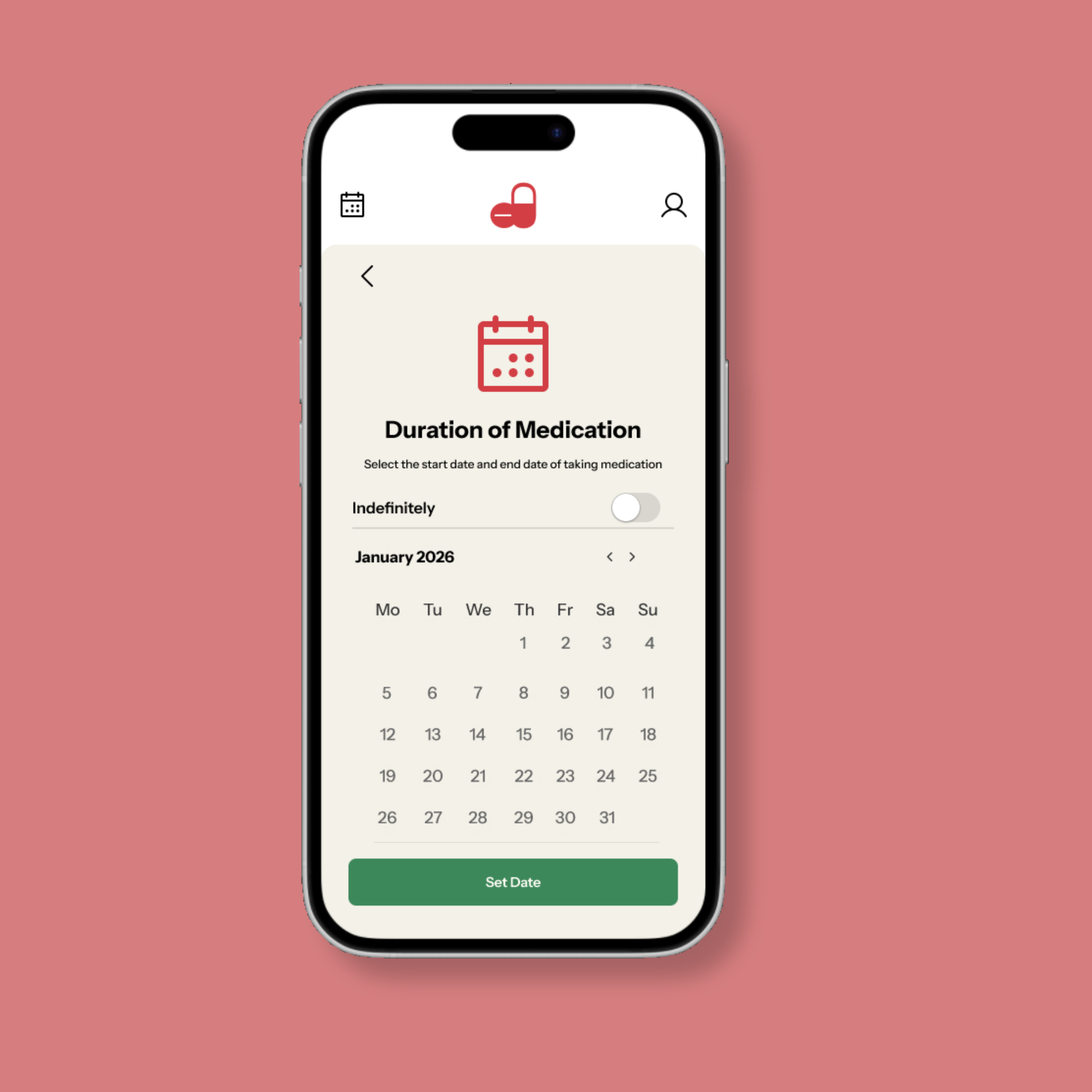
Task 8: Input the duration of medication
Task 9: Confirm the details of medication and add it to the list
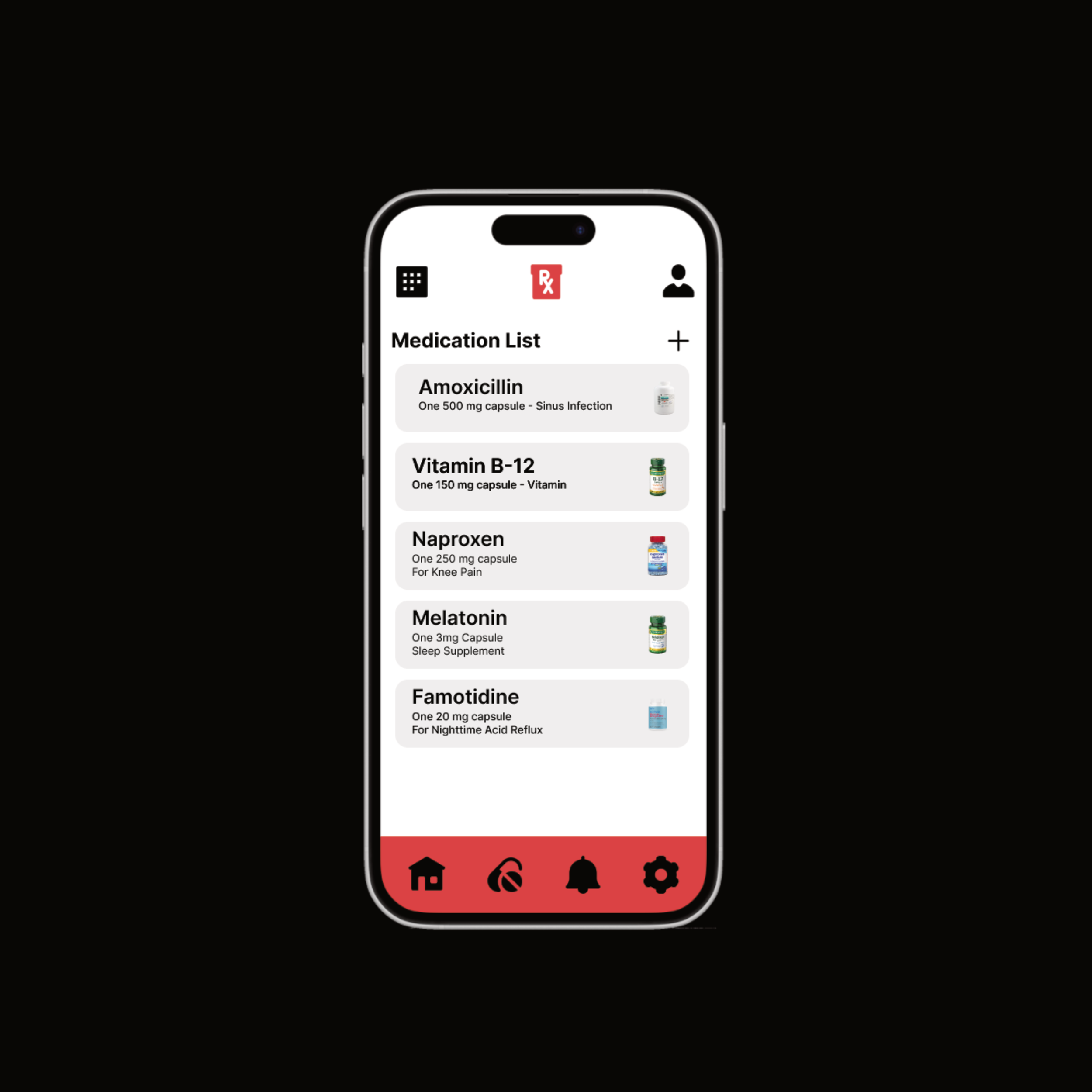
Task 1 Revisions
Rounded Calendar icons to better resemble tablets
Changed photos of medication to color-coordinated icons, along with color-coordinated reminder details
Changed iconography and general color scheme
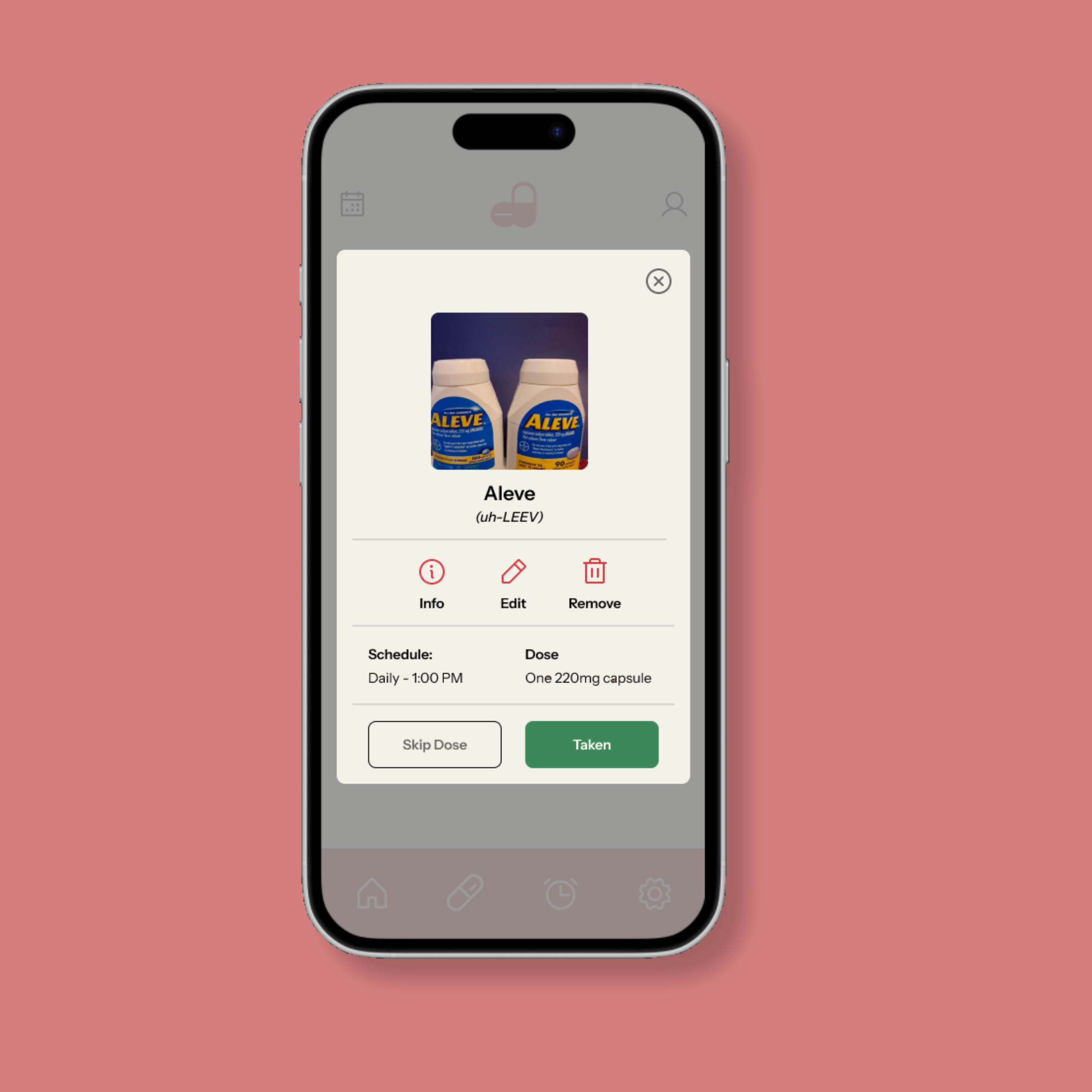
Task 2 Revisions
Created a hovering card for when a medication on the list is selected
Clicking on a medication now gives the user clear instructions for the required actions of said medication
Added extra features such as an information tab and pronunciation of the medication
Task 3 Revisions
Removed the horizontal constraints of the pop up card to emphasize that this is a seperate user flow from the other pages within the app
Changed general iconography and color scheme to be more uniform with the rest of the app
Call to action buttons were made to be bigger and color coordinated
Visual Identity
Colour Palette
Since Dose is a medical app, I chose red and white as the two primary colors for the palette. These colors are frequently associated with the medical field; however, many people feel stressed or anxious when thinking about their health. To address this, I selected warmer tones of red and white to give Dose a more casual, inviting feel, rather than a cold or souless medical experience. The remaining colors were chosen to complement the red and white in their own unique ways.
When creating the logo for Dose, I knew I didn't want to rely on a traditional pill icon to represent the user experience. After several iterations, the final logo features a tablet and a capsule placed upright together to form the letter "D." By combining these two forms, the logo conveys the idea of different medications coming together. Since medication comes in many variations, I felt it was important to represent that diversity throughout the creative direction of this project.